
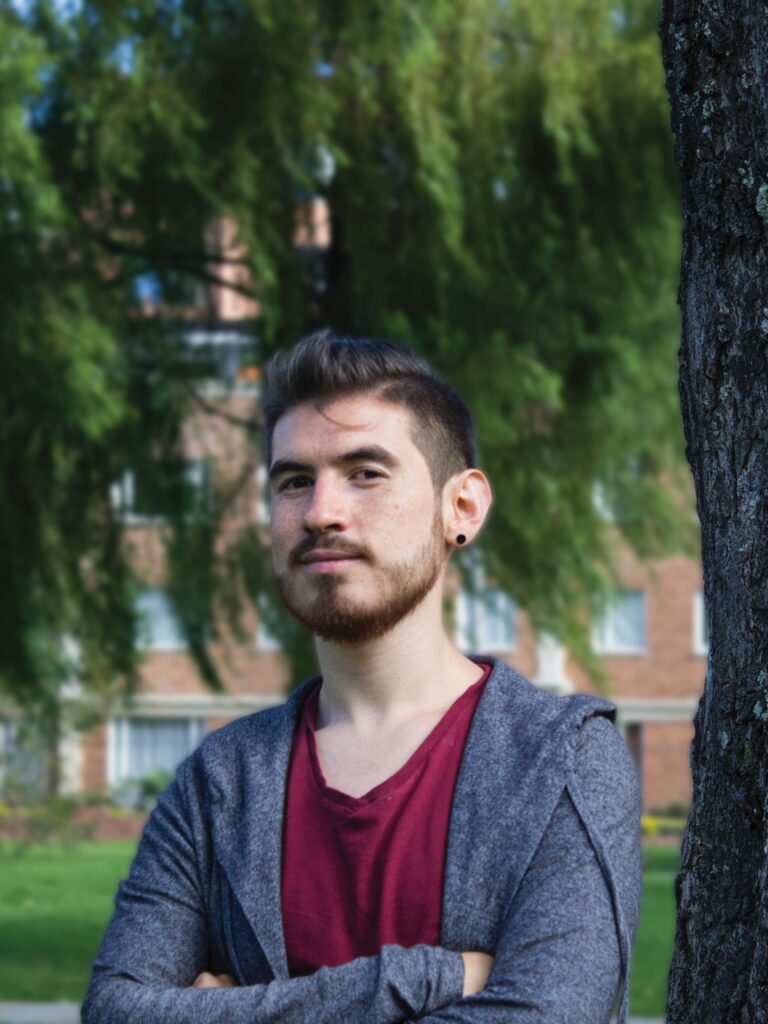
Third in our Changemakers interview series is Santiago Chaparro Garzon, Mobility Fellow with Marygrove Community Development. Santiago will be honored with the Emerging Talent award at Tapestry on November 10 alongside leaders whose work is helping make Southeast Michigan a more welcoming and prosperous region. Santiago is also one of Global Detroit’s current Global EIR founders.
An industrial designer with a master’s degree in transportation design, Chaparro Garzon approaches design as a way of solving problems with—not simply for—people and communities. For him, design does not happen in isolation. It begins by getting involved with the community a project is intended to serve, listening to residents and understanding the realities of their daily lives. That philosophy has taken his career from transportation design to education and, ultimately, community-based work in Detroit.
Last year, Santiago Chaparro was in Global Detroit’s Global Talent Accelerator, a five week job and soft skill accelerator for international students and recent graduates exploring pathways to work in the U.S. He also participated in the New American Leadership Academy as a part of our Opportunity Neighborhoods team.
Was there a particular moment, person, or experience that made you realize this was the work you wanted to do?
When I reflect on my journey, I always think of my dear friend Jay Miguel Meeks, who is also my boss at the nonprofit where I work. He inspired me to change course and steer my professional life toward community-driven work. Through community work, I can interact with residents and learn about the challenges and burdens they face—things that can easily be overlooked when decisions are made without the community being involved.
I feel especially connected to the work happening in the Marygrove community, which has allowed me to think differently about what design can accomplish. I can listen to the people who will actually use what I’m creating and understand how it can improve their quality of life.
How has your professional journey been shaped by your community?
When I came here as a transportation design student and an international student, I imagined my path would lead to the corporate automotive world. Over time, I realized that this was not necessarily right for me. One of my first steps in a different direction was teaching children. That is where I discovered the magic of working with children to create art, helping them see how creative they already are and recognize the value of their ideas. This became one of the most meaningful experiences of my life.
Eventually, I had the opportunity to work with a nonprofit alongside a community association in Marygrove. I was brought in to explore a new mobility system that could better connect residents with local businesses and other destinations around the neighborhood. It is a huge undertaking, and has given me the opportunity to finally bring together my training as a designer with work that directly affects people’s lives. My hope is that what we learn can eventually contribute to how we think about mobility in Detroit and perhaps beyond.
How does your work contribute to the vibrancy and growth of the local community?
Marygrove Community Development works closely with the Marygrove Community Association on projects that improve and care for shared spaces–civic commons–throughout the neighborhood where residents can gather. These spaces invite people to participate in the community–relax in a park, gather produce, cut flowers or simply spend time with neighbors. Activating these spaces also allows for the opportunity to learn about and share the legacy of the neighborhood and the history of the people who created it. In this way, our work in community development is not only about building something new, but about sharing and respecting what was already there.
What keeps you going when the work gets difficult?
I prefer to think of challenges as learning opportunities. This work has given me experience, knowledge and patience, and all of those things have helped me become a better professional. More importantly, it has sharpened my ability to listen. I have learned that meaningful work begins with truly understanding what people are telling you.
I feel extremely grateful to be so engaged with a community that I now consider myself a part of. Whether I am helping at community events, planting flowers and trees in parks, working on a project or simply spending time talking with residents, I am learning what it means to participate in a community rather than simply design for one. For me, much of that comes down to two things: learning to listen and learning to respect.
What does success mean to you beyond the traditional measures of business success?
My professional path has not developed the way I originally imagined it would. As an international student and feeling opportunities were scarce, I decided to create me own path. That led me into education, working with children across Detroit and eventually into community-based work. It changed the way I think about success.
Detroit has a complicated history, particularly for working communities that have experienced disinvestment, displacement, and being overlooked. I want my work to contribute, even in a small way, to communities determining their own futures. This means teaching, studying, meeting people and, above all, respecting the people whose experiences and history made this city what it is. Being recognized for my skills and design thinking means a great deal to me. At the same time, there is still a lot of work to do.
Learn more about Marygrove Community Development here. And if you would like to know more about the Global Talent Accelerator or Global Detroit’s impact in Michigan, visit Our Impact page.
And to join us at Tapestry on November 10 at Jam Handy, get your tickets here: https://globaldetroitmi.org/annual-event/.