
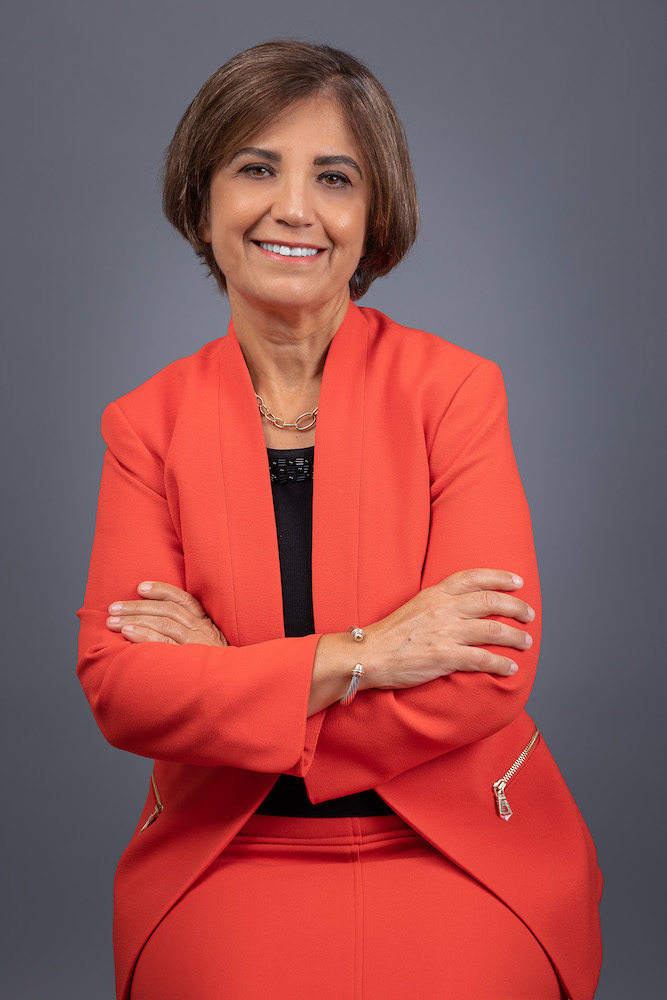
Maha Freij, recently retired President and CEO of ACCESS, is fourth in our series highlighting Global Detroit’s 2026 Changemaker Awardees. She will be honored with the Immigrant Impact award at Tapestry on November 10 alongside leaders whose work is helping make Southeast Michigan a more welcoming and prosperous region. This award honors an established immigrant/ethnic entrepreneur.
For more than 35 years, Freij helped transform ACCESS from a regional human services organization into a nationally recognized institution. Her leadership helped establish the Center for Arab American Philanthropy, strengthen a national network of Arab American community organizations, and raise tens of millions of dollars for major initiatives, including the Arab American National Museum and the new ACCESS Recovery Center. A graduate of Hebrew University with a bachelor’s degree in accounting and economics, Freij is credited as the first Arab/Palestinian woman to earn a CPA license in Israel, which she received in 1989—the same year she immigrated to the United States.
Was there a particular moment, person or experience that made you realize this was the work you wanted to do?
My commitment to justice was shaped very early by growing up Palestinian in a Palestinian town within the state of Israel. We grew up in the shadow of the Nakba, “the catastrophe,” and with an awareness of what it meant when people did not have equal opportunity, representation or the ability to fully realize their potential.
I also experienced barriers personally. I became the first woman CPA of Palestinian descent in Israel and had to navigate being a woman in a male-dominated society while also experiencing inequalities as a Palestinian citizen. Even the way our identity was described could be complicated. Being called “Arab Israeli,” for example, often felt to me like an erasure of my Palestinian national identity.
My mother was a tremendous influence. She believed deeply in education and pushed me to pursue opportunities that had not always been available to women of her generation. Her support meant everything on my journey.
When I came to the United States and eventually found ACCESS, I found a place where I could turn those experiences and values into action. I felt a responsibility—and a privilege—to use the opportunities I had been given to create opportunities for others. That became the foundation of my work: pursuing justice and equity, building opportunity and helping create stronger communities where families could thrive for generations.
How has your leadership journey been shaped by your community?
Everything I have built has been shaped by community. Our community never lacked generosity, talent or ambition. What we needed were strong institutions capable of harnessing that strength and carrying it forward for generations. That belief guided so much of our work. The Arab American National Museum created a national home for our history, stories and culture. Through the Center for Arab American Philanthropy, we worked to move our community from more ad hoc giving toward strategic philanthropy and collective impact. Through the National Network for Arab American Communities, we helped grassroots organizations across the country strengthen their capacity to serve and advocate for their communities.
Most recently, we cut the ribbon on the nearly 53,000-square-foot ACCESS Recovery Center after years of work. It grew from recognizing a profound community need and asking what kind of institution could address that need in a more comprehensive, whole-family way. For me, entrepreneurship has never simply meant creating something new. It means building something that can endure—institutions that will continue serving, strengthening and empowering people long after any one of us is gone.
How does ACCESS contribute to the vibrancy and growth of the local community?
ACCESS started in a storefront in Dearborn 55 years ago because people saw needs around them and decided to act. Today, nearly 500 staff across 11 facilities carry that same spirit forward, providing services in 23 languages. We help people build healthier and more economically secure lives, while also creating places where people can connect, contribute, celebrate their identities and participate fully in their communities. We are proudly rooted in the Arab American community, but we serve people of every background. We have always believed that strengthening our community also means strengthening Southeast Michigan as a whole.
What keeps you going when the work gets difficult?
First, my family. I could not have done this work without the support of my husband, Roy, and our sons, Laith and Omar. They have shared in the sacrifices, believed in the work and become philanthropists themselves. This journey has never been mine alone.
I am also continually inspired by the people we serve and the people I have had the privilege of working alongside. Over the years, I have witnessed the extraordinary and selfless commitment of people at ACCESS who show up every day because they genuinely believe in serving others. When the work gets difficult, seeing the impact firsthand—and seeing how one opportunity can change the trajectory of a person or an entire family—reminds me why the work matters and keeps me moving forward.
What do you consider your proudest achievement in your work? Why?
I am proudest of the seeds we have planted—in people, institutions and movements—that will continue to grow for generations. The Arab American National Museum gave our community a national home where our history, stories and culture can be preserved and shared. The Center for Arab American Philanthropy helped change how we think about giving and created infrastructure for strategic philanthropy. The National Network for Arab American Communities strengthened the capacity and collective impact of grassroots organizations around the country. And now, the ACCESS Recovery Center represents a new model for compassionate, whole-person recovery that can transform lives and families.
But what makes me proudest is not any one building or program. It is knowing that we built institutions, developed people and helped create movements that can continue growing long after my own time in leadership has ended. Growing up Palestinian taught me a great deal about justice, identity and belonging, but I also grew up with a profound sense of family, community, generosity and responsibility to one another. Those values have influenced virtually everything I have done. Whether through human services, culture, philanthropy or advocacy, my life’s work has been about creating the institutions, opportunities and sense of belonging that allow people and communities to shape their own futures for generations.
Global Detroit will honor Maha Freij and the other 2026 Tapestry Changemaker Awardees at Tapestry on November 10. The annual celebration recognizes individuals and organizations whose leadership demonstrates how immigrant inclusion and global connections strengthen Southeast Michigan.